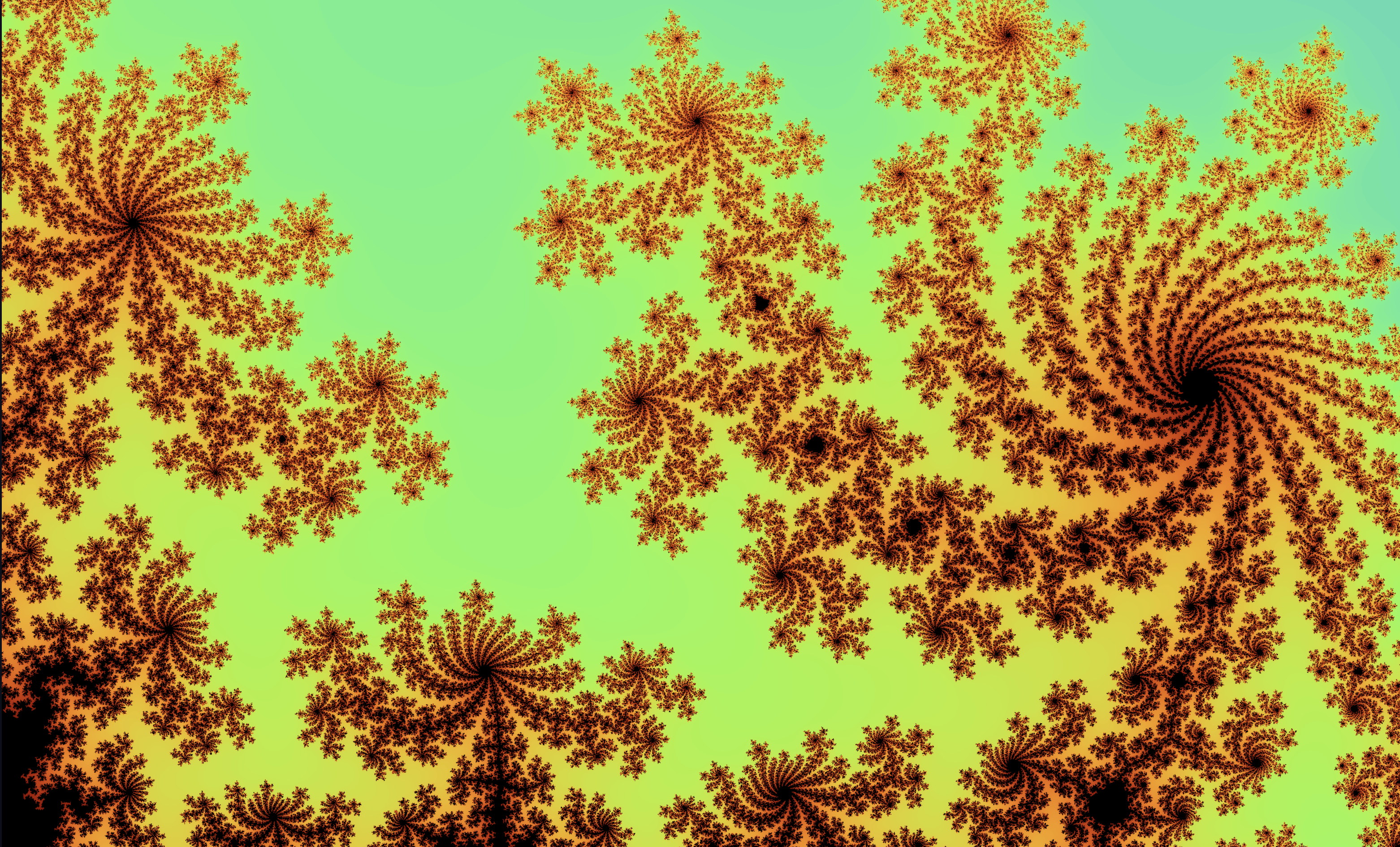
Mandelbrot set
An interactive zoomable plot of the Mandelbrot set rendered on canvas.
January 08, 2023
Mandelbrot set
An interactive canvas rendering of the Mandelbrot set. Scroll to zoom, drag to pan, double-click to reset.
How Far You Can Zoom
The zoom is capped at ten billion times the opening view, set by scaleExtent([1, 1e10])
on the d3 zoom behaviour. The initial window spans 3.5 units of the real axis, so at full
magnification you are looking at a slice about 0.35 nanometres wide. If the first frame
were a metre across, the deepest zoom would be roughly the width of an atom.
Two things limit how deep it is worth going, and floating point arithmetic is not the first of them.
Iteration count. The render stops at 256 iterations. Deep inside the boundary, points
need far more than that to escape, so they are all painted as interior and the colour
bands flatten into solid shapes. Detail washes out well before the arithmetic does.
Raising maxIter buys more structure at the cost of render time, since cost scales with
iterations times pixels.
Double precision. JavaScript numbers are 64 bit floats carrying about 16 significant digits. At the cap, with a canvas around a thousand pixels wide, neighbouring pixels sit 3.5e-13 apart in the complex plane, still almost three orders of magnitude above the 4.4e-16 resolution of a double near the edge of the set. Precision would only start to grain up somewhere past 1e12, which is why the cap sits comfortably below it.
Renderers that reach 1e100 and beyond abandon hardware floats entirely, using arbitrary precision arithmetic with perturbation theory, computing one high precision reference orbit and expressing nearby pixels as small offsets from it.